


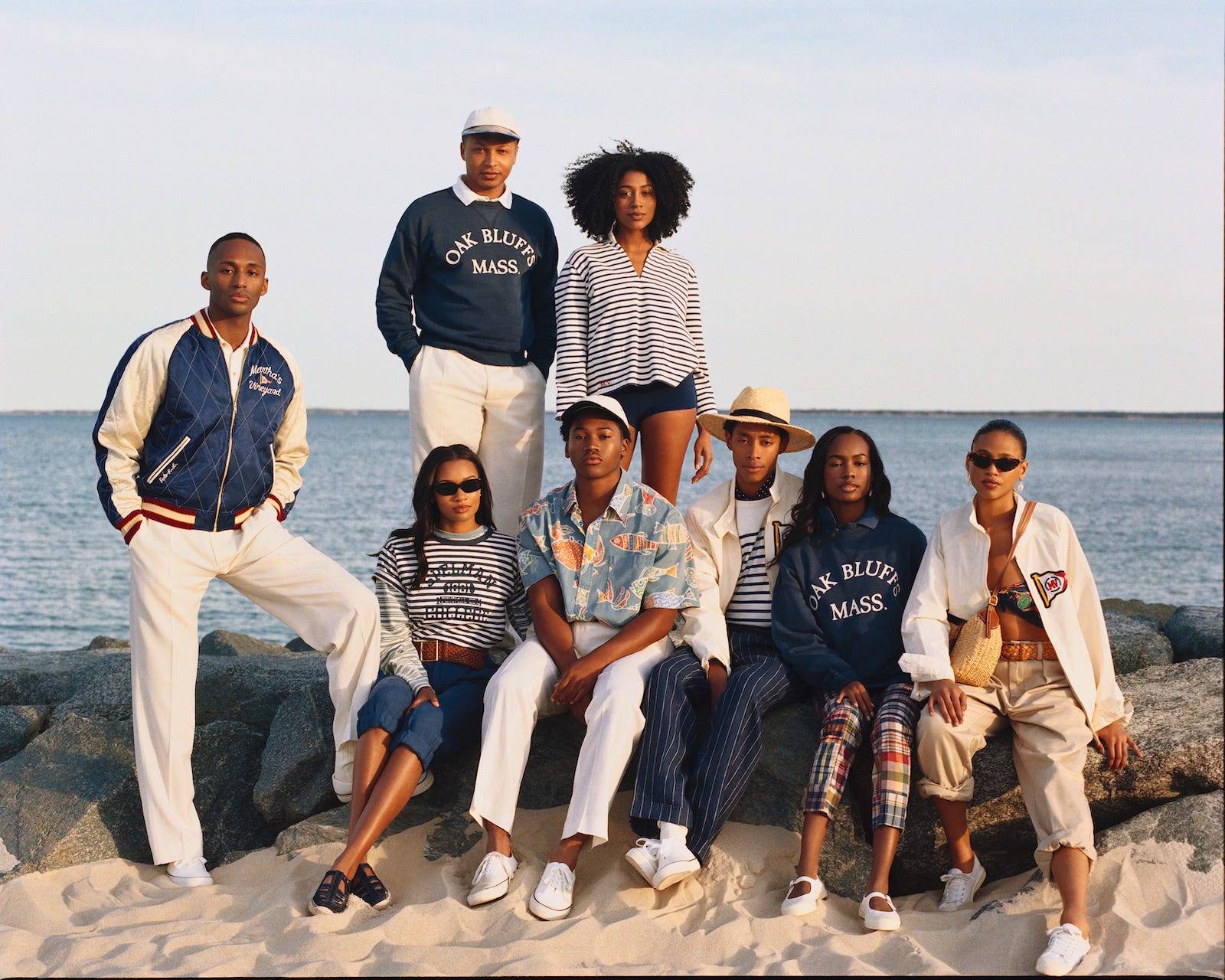
It’s Martha’s Vineyard season for our kind of people. The Blacks are party-hopping, rubbing shoulders with celebrities, threading & posting their whereabouts, and complaining about the particular exhaustion that comes with too much grandeur. Everybody is booked, busy, invited, photographed, and seemingly in the room. And this year, as with every year, the Vineyard isn’t just happening on the Vineyard. It’s happening online too. We’re watching outfits, dissecting parties, discussing who got invited where, who clearly didn’t know the assignment and, increasingly, debating what proper Black etiquette and decorum should look like in these spaces.
And while I’ve never particularly enjoyed PR or loud, public praise, I get these subtle reminders every now and then that I’m still—or perhaps am—one of those girls. The calls still come. The automatic RSVPs. The “save the date” texts. The calendar invites. The you’re coming, right? messages that don’t even bother asking whether I knew the thing was happening in the first place. And the funny part is, I’m not on the Vineyard. I’m not at the party, and half the time, I’m not even in the “room” of the moment. It’s the assumption that I’m there that tickles the hell out of me, but lately it’s also made me think about all the other rooms where I’m not granted the same “pink-carpet” treatment.
Because Martha’s Vineyard —particularly the Black social scene around Oak Bluffs—has always represented more than a vacation destination. For generations, it has been a gathering place for Black families, professionals, artists, academics, politicians, and the upwardly mobile. There is history there, community there, and a very real cultural significance that shouldn’t be reduced to Instagram stories and party invitations. But in the age of social media, the Vineyard has also become something else: a highly visible stage for Black status, access, and belonging. For one week, your timeline becomes a digital yearbook of who was there, what they wore, whose house they visited, and which invitation they secured.
Which is probably why the conversations about etiquette have become so interesting to me. Every Vineyard season, there seems to be some variation of the same debate: people complaining about behavior, attire, entitlement, houseguest etiquette, party crashing, networking too aggressively, or treating someone’s home like a sponsored activation. Underneath some of those conversations are legitimate discussions about respecting people’s homes, communities, and traditions. But underneath others, if we’re being truthful, is something much more complicated: Who belongs here? Who knows how to behave here? And who needs to prove that they belong?
That distinction matters.
Because Black people have always had our own systems of class, access, and social capital. We know the difference between being invited somewhere and being invited somewhere. We know what it means when somebody says, “Come through,” versus when your name is actually on the list. We understand that there are rooms where the currency isn’t necessarily money; it’s relationships, pedigree, profession, affiliations, education, family name, social fluency, or simply knowing somebody who knows somebody.
And when you’ve spent enough of your life learning how to navigate those rooms, it’s easy to confuse access with affirmation.
Lately, I’ve been subscribing to telling people less and less about my life, my career, and my goals. Sometimes I’ll even throw a little razzle-dazzle into the conversation and let people underestimate me, because frankly, I’m burnt out from trying to impress people. I didn’t realize how much energy that required until I started stopping.
For many of us, ambition started innocently enough. We wanted stability, options, and the ability to make our families proud. We wanted the degree, the job, the house, the salary, and the life that proved all those sacrifices meant something. Somewhere along the way, though, achievement became evidence: evidence that we were smart, that we belonged, that we had escaped whatever circumstances we were determined not to repeat and, maybe if we’re willing to admit it, evidence that we were worthy.
For Black professionals, there can be another layer. We often navigate environments where our competence may be questioned before it’s ever assumed, so we learn to bring receipts. We become overprepared, overcredentialed, and overextended because we’ve learned that the safest position is to make the work undeniable. Then we enter our own social spaces carrying some of those same instincts. Now we’re not proving ourselves to white corporate America; we’re proving ourselves to each other.
That’s where some of the Vineyard discourse becomes fascinating.
When does etiquette become respect for community, and when does it become respectability politics? When does preserving the culture become policing who gets access to it? When does networking become social climbing? When does dressing appropriately become proving that you understand the codes of a certain class? And when does being “in the room” stop being about community altogether and become evidence that you’ve arrived?
Because you can absolutely spend a week on Martha’s Vineyard exhausted from performing success.
You can have the right outfit, attend the right events, know the right people, get the right pictures, and still spend the entire trip quietly measuring yourself against everybody around you. Who has the bigger title? Who has the better house? Who got invited to the private dinner? Who knows the celebrity personally? Who was merely at the event and who was actually with the people hosting it?
That’s not leisure. That’s labor with cocktails.
Social media simply gives us an audience for the performance. New job? Announce it. Promotion? Announce it. Bought something? Show it. Got invited somewhere exclusive? Check in. Met somebody important? Get the picture. We’re constantly building a case that says, See? I’m doing well. See? I belong here.
But what happens when nobody is watching? Would you still want the invitation if nobody knew you received it? Would you still want to be on the Vineyard if you couldn’t post a single picture? Would you still care about getting into that particular party if nobody could see that you were there? Would you still want the promotion if you couldn’t announce it? Would you still buy it if nobody ever saw you wearing it? Would you still pursue that career if nobody found the title impressive?
Would you still want your life if you couldn’t explain it to anybody?
Those questions get uncomfortable quickly because sometimes we discover we’ve been pursuing things we don’t actually want. We want what possessing them says about us.
I’m becoming increasingly fascinated with privacy. Not secrecy, but privacy: the ability to experience something without immediately turning it into content, conversation, or proof. There’s something luxurious about people not knowing exactly what you’re doing, what you’re working on, what you make, who you know, where you’ve been invited or what’s next. And perhaps the greatest luxury is not feeling compelled to correct whatever assumptions people make in the absence of that information.
I’ve spent enough of my life making sure people understood exactly who the hell they were dealing with.
These days, sometimes you can just be wrong about me. I don’t have to pull out my résumé, casually mention the title, explain the connection, or provide context that suddenly makes you see me differently. That might actually be one of the clearest signs that external validation is loosening its grip: you stop needing to manage everyone’s perception of you.
Maybe that’s the question underneath burnout that we don’t ask enough. Burnout isn’t always about having too much work. Sometimes we’re exhausted from maintaining an identity: the successful one, the ambitious one, the well-connected one, the impressive one, the one who’s always doing something, the one everybody assumes will be in the room. There is a particular kind of exhaustion that comes from constantly living up to the version of yourself everybody else has already decided you are.
And maybe the Vineyard discourse is unintentionally giving us an opportunity to examine that. Etiquette matters. Respecting people’s homes matters. Understanding the history of Black spaces matters. Community matters. But we should also be careful not to turn our spaces of Black joy into another institution where everybody is auditioning for acceptance. We already spend enough of our professional lives code-switching, proving, credentialing, and demonstrating that we know how to behave in somebody else’s rooms. We shouldn’t recreate that same exhaustion for one another.
I still like very nice things. I still have goals. I still enjoy walking into certain rooms and knowing I earned my way there. I’m not pretending I’ve transcended ego or that an invitation doesn’t occasionally make me smile. Hell, the assumption that I’m somewhere I’m not planning to visit till later this summer still tickles me. But I’m learning to interrogate the desire before I chase it: Do I want this because it expands my life, or because it validates my life?
Perhaps the next level of ambition isn’t accumulating more things for people to admire. Maybe it’s building a life that feels good even when nobody is watching—a life you don’t have to announce, defend, or constantly provide evidence for, and one that doesn’t require applause to feel significant.
But have you ever thought that maybe the bigger flex isn’t getting invited to every room? Maybe it’s reaching a point where your sense of belonging isn’t determined by whether you were invited at all.
Because eventually, we all have to answer the question after the party ends, the pictures stop posting, and everybody flies home:
Who are you when nobody is impressed?
so many gems dropped here, and i love that most are framed as questions. we’ve all got work to do!
I’m not there yet. But I am noticing what is no longer sacred in Black American culture.